
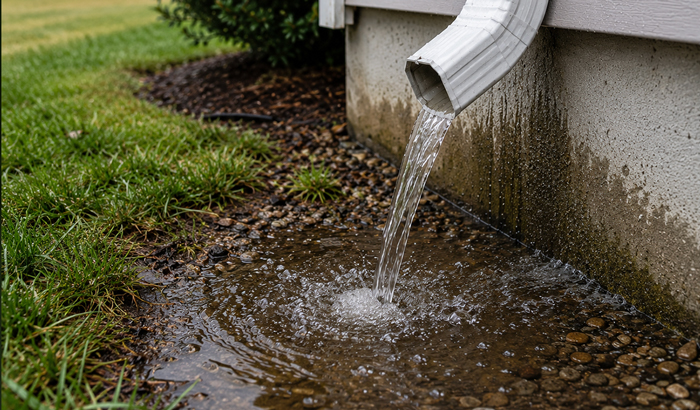
A lot of homeowners put time and money into cleaning their gutters and maintaining their system — and still end up with water against their foundation. The reason is usually the same: the gutters are moving water off the roof, but the downspouts are depositing it right next to the house.
Getting water away from your foundation is the final step that completes the system.
Why Downspout Placement Matters
A standard downspout terminates at ground level, typically with a short elbow that directs water a few inches away from the house. During a heavy rain, that means hundreds of litres of water are being deposited within arm’s reach of your foundation every hour.
- Water that pools near the foundation saturates the soil and creates hydrostatic pressure against foundation walls.
- In Ontario’s freeze-thaw cycles, repeatedly saturated soil expands and contracts — pushing against and eventually cracking foundations.
- Even without foundation damage, a consistently wet perimeter creates ideal conditions for basement seepage through cracks and mortar joints.
Downspout Extensions — The Simple Fix
The easiest and most affordable solution is a downspout extension — a section that attaches to the end of the downspout and carries water further from the house before releasing it.
- Rigid aluminum extensions are durable and blend with the existing system.
- Flexible corrugated extensions can be angled around obstacles like flower beds or walkways.
- The minimum recommended distance from the foundation is 4 feet — further is better on flat or low-graded lots.
- Extensions should deposit water onto a surface that slopes away from the house — directing water toward a flat or low area defeats the purpose.
Downspout extensions work best when the ground naturally slopes away from the house. If your yard grades back toward the foundation, water will find its way back regardless of where the downspout ends.
Splash Pads and Splash Blocks
Where a downspout deposits water onto soil, a splash pad or splash block prevents erosion at the discharge point and helps direct flow away from the house.
- Concrete or rubber splash blocks sit under the downspout elbow and deflect water away from the foundation.
- Decorative river stone or gravel beds absorb impact and allow water to percolate slowly without channeling.
- Without any protection, constant discharge onto bare soil creates a hole that gradually slopes back toward the foundation.
Underground Drainage — The Permanent Solution
For homes where surface extensions are not practical — tight lots, finished landscaping, paved areas — underground drainage is the cleanest solution. The downspout connects to a buried pipe that carries water to a discharge point well away from the house.
- Pop-up emitters release water at grade when the system is active and close when dry — no standing pipe visible in the yard.
- Discharge points should be at least 10 feet from the foundation and directed away from neighbouring properties.
- French drain connections are possible for homes with significant drainage challenges.
- Underground systems require occasional flushing to prevent sediment buildup — typically every few years.
Connecting to the Municipal Storm System
Some older homes in Ontario have downspouts connected directly to the municipal storm sewer through buried pipes. If you have this setup, it is worth knowing that many municipalities have moved away from this practice or banned it. Storm systems can be overwhelmed by roof runoff, and a blocked connection sends water straight to your basement instead.
- If you are unsure whether your downspouts are connected underground, check with your municipality.
- Disconnecting from the storm system and redirecting to surface discharge is now required in many Ontario municipalities.
A Complete System Thinks About Where Water Goes
Clean, well-maintained gutters that move water efficiently to a downspout — and then deposit it next to the foundation — are only doing half the job. The complete picture includes where that water ends up.
If you have had basement moisture or foundation concerns and your gutters have always seemed fine, the downspouts and their discharge points are worth a close look.
We Can Help
Gutter Protect serves Brantford and the surrounding area. Whether you need a cleaning, a repair, an inspection, or honest advice, we’re a call away.
Call or text: 519.732.0081
Website: gutterprotect.ca
Serving: Brantford, Ontario and surrounding communities
Protect what matters.